From Idea to Output: How Small Teams Are Scaling Visual Content With AI

Công nghệ phân tích hóa sinh tự động trong kiểm tra chất lượng sản phẩm
20 July, 2026
TS Nguyễn Đức Chinh: Bỏ bàn giấy về với nông nghiệp hữu cơ – Công nghệ trong nông nghiệp
20 July, 2026
Last updated on 23 July, 2026
Small teams face a familiar tradeoff: they have the ideas and the ambition of a much larger organization, but not the headcount or budget to match. Nowhere is this more obvious than in visual content production, where a two-person startup team is often expected to produce the same volume and quality of video and graphics as a company with an entire creative department. Looking at how small teams are actually solving this problem — rather than how they’re theoretically supposed to solve it — offers a useful, practical picture of where content production is heading, and tools like AI Video Maker are showing up repeatedly in that picture.
The Resource Gap Small Teams Face
A small team launching a product, running a niche media brand, or managing a growing social presence typically doesn’t have a dedicated editor, designer, or videographer. Instead, one or two people are responsible for everything from strategy to execution. This creates a natural ceiling on output — not because the ideas run out, but because there simply isn’t enough capacity to turn every idea into finished content.
This gap becomes especially visible during growth phases. As an audience expands, the expectation for consistent, higher-quality content grows with it, but the team’s size usually doesn’t grow at the same rate. The result is a widening gap between what the audience expects and what the team can realistically deliver without burning out.
How Teams Are Closing the Gap
Looking at how small, resource-constrained teams have adjusted their workflows over the past couple of years reveals a consistent pattern: they are relying much more heavily on AI-assisted tools to handle the parts of production that don’t require unique human judgment.
Draft Generation Instead of Blank-Page Starts
Rather than starting a video or graphic from scratch, teams generate an initial draft using AI tools and then refine it. This shifts the team’s time from production to editing and quality control, which is usually a faster process.
Parallel Content Production
Because generation is fast, teams can produce several versions of a video or image concept at once and select the strongest option, rather than committing significant time to a single version before knowing whether it will perform well.
Cross-Format Repurposing
A single piece of source material — a script, a product description, a key message — can be turned into a video, a set of images, and supporting graphics without redoing the creative work for each format separately.
A Practical Example
Consider a small e-commerce team preparing to launch a new product. In a traditional workflow, this would typically involve briefing a designer for product graphics, coordinating a videographer for a promotional clip, and waiting several days — sometimes longer — for revisions to come back. For a team of two or three people, that timeline can delay a launch significantly or force it to happen with incomplete assets.
Using an AI-assisted workflow, the same team can generate promotional visuals with a tool such as an AI Image Maker, produce a short launch video from the product description and key selling points, and iterate on both within the same day. The team still makes every meaningful creative decision — what the product’s story is, what tone fits the brand, which visual direction feels right — but the execution time drops from days to hours.
This kind of compressed timeline doesn’t just save time; it changes what’s possible. Launches that would previously have required weeks of lead time for asset production can be planned and executed on much shorter notice, which matters a great deal for teams operating in fast-moving markets.
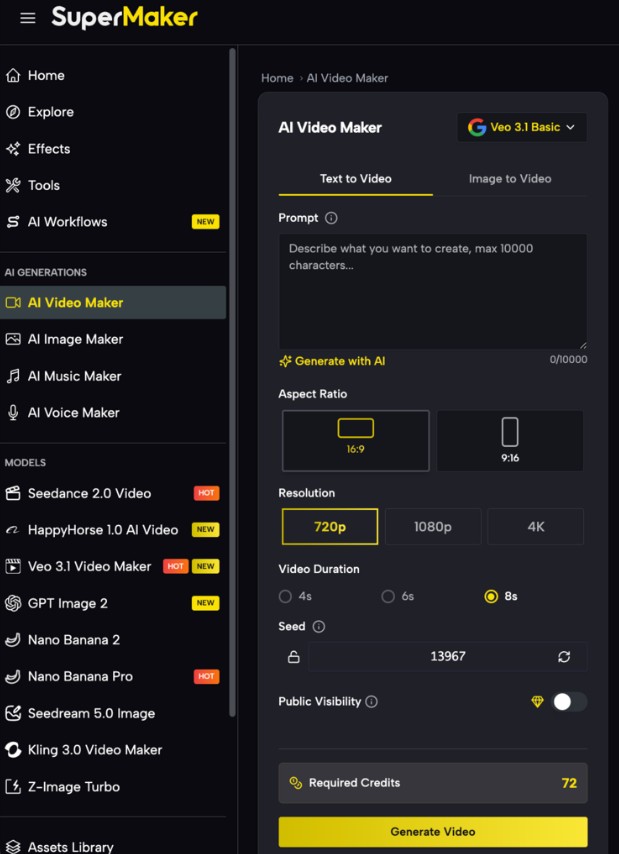
AI Video Maker Prompt Window
What the Data Suggests About This Shift
While every team’s numbers look different, a consistent theme shows up in how small teams describe this shift: the biggest gains come from time saved on the type of content that occurs frequently but doesn’t require a fully custom approach — a routine promotional video, a social graphic, a product image update. High-stakes, brand-defining assets still tend to get extra manual attention, but the volume of routine content that used to compete for the same limited time no longer creates a bottleneck. This reallocation of time, rather than a raw increase in output, is usually the most meaningful change small teams report after adopting AI-assisted production.
Where This Approach Has Limits
It’s worth being clear-eyed about where this approach works well and where it doesn’t. AI-generated content tends to perform best for high-volume, lower-stakes assets — the kind of content that needs to exist and be reasonably good, but doesn’t carry the weight of a flagship campaign. For a brand’s most important assets — a major launch video, a signature visual identity piece — most teams still invest more manual time and human oversight, using AI-generated drafts as a starting point rather than a finished product.
Teams that get the best results tend to be deliberate about this distinction, rather than applying the same level of automation to everything regardless of importance.
Lessons From Teams That Made the Transition Smoothly
A few other patterns show up repeatedly among teams that adapt well:
Someone Owns a Quality Bar
Even in a two-person team, having one person responsible for reviewing AI-generated output before it goes out the door prevents inconsistent quality from slipping through, especially in the early weeks of adoption when the team is still learning what the tool does well.
Feedback Loops Stay Short
Teams that review results weekly — what worked, what needed heavy editing, what saved the most time — tend to refine their process faster than teams that adopt a tool once and never revisit how they’re using it.
Expectations Are Set Realistically
Teams that expect AI tools to eliminate all manual work tend to be disappointed and abandon the approach. Teams that expect a meaningful reduction in production time, while still planning for review and refinement, tend to stick with it and see compounding benefits.
On the other side, teams that struggle with adoption often share a different pattern: they try to apply AI-generated content uniformly across every asset type, including high-stakes pieces that genuinely benefit from more manual attention, and become frustrated when those specific outputs don’t meet expectations without additional work. The lesson isn’t that the tools underperform — it’s that matching the right use case to the right tool, and being clear about where manual oversight is still needed, makes the difference between a smooth transition and a frustrating one.
For teams just starting out, the most reliable path tends to be starting small, tracking actual time saved rather than assuming it, and expanding usage gradually as confidence in the process builds.
Conclusion
The pattern across small, resource-constrained teams is fairly consistent: AI-assisted video and image production isn’t replacing the team’s creative judgment, but it is dramatically reducing the time between having an idea and having something publishable. For teams that don’t have the luxury of a large creative department, that time savings often makes the difference between an idea that gets executed and one that stays on the list indefinitely. As more teams adopt this approach, the gap between what small teams and large organizations can produce is likely to keep narrowing.